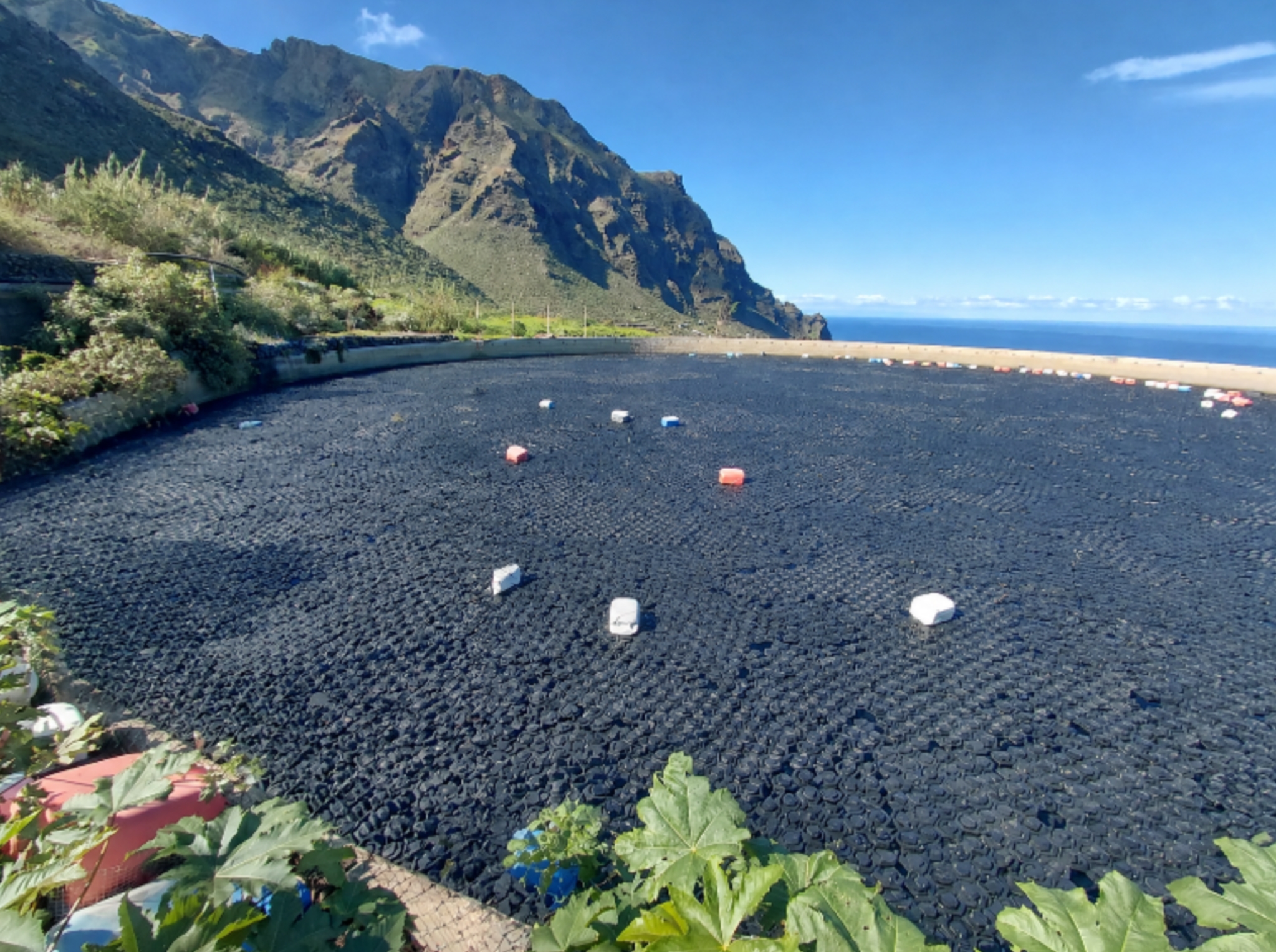
Process, effluent and storage ponds: close the surface without touching the plant.
An open pond at a chemical plant loses water you already paid to treat, grows algae that reach your equipment, and releases to the air whatever the wind can strip off the surface. Covex® floating cover seals 98% of it: evaporation down by up to 97%, algae by over 90% and odor emissions by over 90%. No structures, no anchoring, no draining the pond.
An open pond is a piece of process equipment nobody specified.
Process water, cooling water, equalization and effluent ponds are usually the only part of a chemical plant left open to the sky. That one design decision hands three variables to the weather: how much water you lose, how much biology grows in it, and how much of what is dissolved in it leaves through the surface. None of the three is measured on a P&ID, and all three end up on someone's budget.
You lose water you already treated
Water in a process pond has been through intake, treatment and pumping before it gets there. What evaporates takes that cost with it, and leaves behind a more concentrated liquid that is harder to handle downstream.
Algae reach the equipment
Sunlight on a pond with any nutrient load grows algae that block strainers and filters, foul exchanger surfaces, shift pH and force extra dosing. The cost arrives as maintenance hours and chemicals, not as a water bill.
What the wind takes, the neighbors notice
Every square meter of open surface is an emitter, and wind sweeping across the liquid strips compounds off it and carries them downwind. That is why complaints peak on warm, windy afternoons and come from people who cannot see the plant.
Evaporation, algae and emissions share one cause: the open liquid surface.
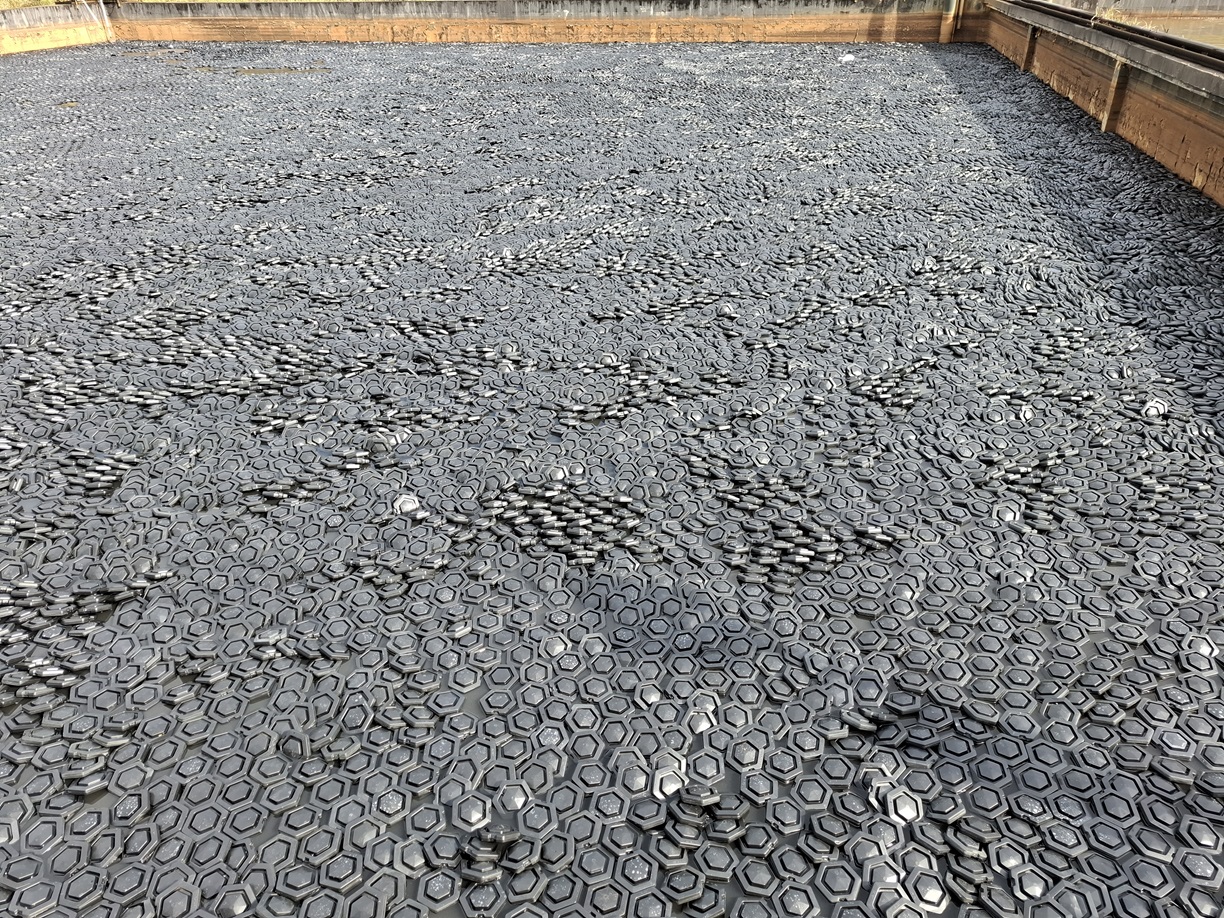
Covex® is a modular cover of hexagonal HDPE units that float and interlock on their own. It covers 98% of the surface in a stable, permanent way thanks to its aerodynamic design, its factory-sealed water ballast and its minimal freeboard.
- 98% less exposed surfaceVapor and odorous compounds are left with only the small gaps between units to escape through.
- No wind strippingAir moves over the cover, not across the liquid, so the wind stops pulling compounds out of the pond.
- No light, no algaeBlocking sunlight cuts algae growth by over 90%, which keeps strainers, filters and exchanger surfaces clean.
Two numbers, two methods, neither of them a brochure figure.
Odor was measured by an independent environmental laboratory using dynamic olfactometry on side-by-side ponds of high-load effluent, one covered and one left open, under still air and under forced airflow across the surface. Evaporation is not measured, it is modelled: we run a full energy balance on the water surface with an in-house tool built on TRNSYS, fed with the meteorological file for your coordinates.
The odor reduction was greatest under airflow, the exact condition that carries emissions from a pond to a community.
Results depend on climate, pond geometry, coverage achieved and the characteristics of the liquid. Every Covex® project is sized on your site data.
Send us the pond area and its coordinates and we will model what it loses today.
Model my pondDesigned for ponds that cannot stop and liquids that are not just water.
HDPE, and we check your analysis
Covex® is made of HDPE, the polymer used in liners and chemical storage, with antioxidant and UV additives. Operating range from -40°C to 85°C. For liquids with unusual chemistry we review your analysis before quoting, and we will say no if the service is wrong for the material.
Ballast sealed at the factory
Each unit carries water ballast sealed during manufacturing. Nothing is filled on site, and no unit ever takes on the liquid it is floating on.
It floats around your equipment
Inlets, outlets, pumps, level sensors and sampling points stay where they are. Units float freely around fixed equipment and we plan the access zones your operators need to keep clear.
It follows the level
Batches, rainfall and plant load move the pond level every week. The cover rises and falls with it and re-levels by itself, with no cables, anchors or tensioning.
Rain goes through
Rainfall drains between units into the pond. No standing water on top, no rainwater pumps, no sheet sagging under its weight.
Installed without an outage
The pond keeps operating while the cover goes on, and at the end of its life the units are fully recyclable HDPE rather than a contaminated membrane to dispose of.
Process pond, effluent lagoon or storage pond? Tell us about the site and we will size a cover for it.
Talk to a specialistHow Covex® compares with the other ways to close a process pond.
| Covex® | Floating membrane | Structural cover | Neutralizer misting | |
|---|---|---|---|---|
| Acts at the source | Yes | Yes | Yes | No, treats the air |
| Cuts evaporation | Up to 97% | High | High | No |
| Energy or chemicals in operation | None | Rainwater pumping | Ventilation, usually | Continuous |
| Pond drained to install | No | Often | Usually | No |
| Level changes | Self-levelling | Needs ballast and slack design | Fixed structure | Not applicable |
| Rainwater | Passes through | Must be pumped off | Gutters and drainage | Not applicable |
| Equipment on the pond | Units float around it | Needs penetrations | Needs clearance | Not applicable |
| If something fails | One unit, replaced by hand | A tear affects the sheet | Structural repair | Emissions return at once |
| Vapor capture and treatment | No | Possible | Possible | No |
Typical characteristics of each technology; specific products vary. If you need to capture and treat the vapor stream, a sealed membrane or a structural cover with extraction is the right tool. If you need to keep the water and cut emissions with no operating cost, Covex® is.
Comparing options for your site? We will put together a side-by-side for your pond.
Get my comparisonInstalled while the plant keeps running.
Site data
Pond area and geometry, coordinates, liquid analysis, equipment on the surface, operating levels and wind exposure.
Review and quote
Material compatibility against your analysis, energy balance on your meteorological file, then sizing at 50 units per square meter.
Release on the pond
Units are released from the bank and spread and interlock on their own. No draining, welding or anchoring, and no plant outage.
Operation
Periodic visual inspection only. At the end of its life, the cover is fully recyclable.
Questions process engineers ask us.
Will it resist my liquid?
HDPE has broad chemical resistance and is the standard material for liners and chemical storage, but that is not a blanket yes. Send us the analysis, the temperature and the pH range, and we will tell you whether the service is suitable before anyone writes a quote. Where it is not, we say so.
Is Covex® gas-tight? Can it capture a vapor stream?
No. Covex® reduces emissions by limiting the exposed surface and keeping the wind off the liquid; it is not a gas-tight membrane and it does not feed a scrubber. If your permit requires capture and treatment, a sealed system is the right choice. If it requires cutting what leaves the pond, with no operating cost, Covex® is.
What temperature can it take?
The operating range is -40°C to 85°C. Above that we do not quote. If your pond runs hot, tell us the real operating temperature rather than the design one, because the evaporation model needs it too.
Can it be used on aerated or agitated ponds?
Covex® is best suited to storage, equalization and holding ponds. Where there are surface aerators or strong turbulence, we evaluate the layout case by case and may cover only part of the surface.
What happens in strong wind?
Covex® XT50 is designed for winds up to 100 km/h. In strong gusts some units may stack temporarily, but floating units do not blow away and the cover re-levels by itself. Units left on the slope when the level is very low are the most exposed, so we review your operating levels as part of the study.
How do I verify the result?
For odor, we recommend measuring before and after installation with your environmental consultant, and we help define the protocol so the comparison holds up. For evaporation, the model gives you the expected figure and your own water balance confirms it over a season.
Let's do the numbers.
Tell us the pond area, where the site is and what the liquid is. A Covex® specialist will come back with a compatibility review, a sizing and a quote.
Read before you specify.
Material written for process and environmental teams, not for procurement brochures.
Evaporation, algae and emissions on open process ponds
Technical articles on what drives evaporation on an open surface, why algae return after every treatment, and why odor peaks when the wind picks up.
Compatibility review, sizing and quote
Send us the liquid analysis, the pond area and its coordinates, and we return a material compatibility review, the water it loses today, a sizing and a quote.