Cut the emissions at source.
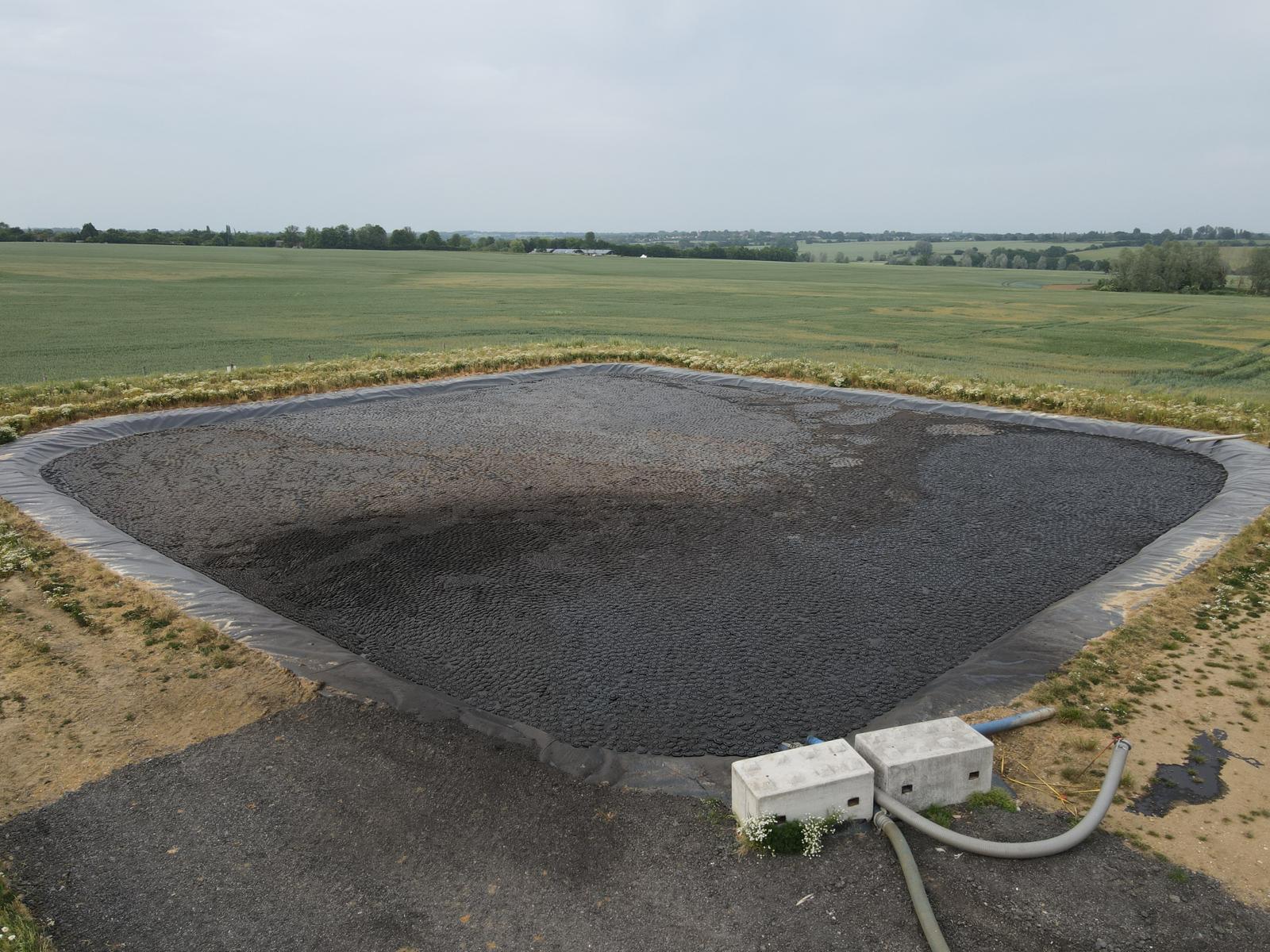
Covex® is a modular hexagonal floating cover for digestate lagoons, slurry stores and AD liquor. By covering the liquid surface it reduces odor, ammonia and methane emissions at source, supporting a BAT-aligned permitting case, with no pumps, no membranes and no moving parts to fail.
An open digestate lagoon emits across its whole surface.
Every open store of digestate or slurry exchanges gas with the air across its entire exposed surface. That single interface is where odor reaches neighbours, where ammonia and methane escape to atmosphere, and where the regulator expects to see a control measure in place.

Odor and the community
Volatile compounds and amines leave the open surface and travel to nearby properties. Odor complaints are the single most common trigger for regulatory pressure on AD and agricultural sites.
Ammonia and methane to atmosphere
Stored organic liquids volatilise ammonia (NH₃) and release methane (CH₄). Both are emissions the permit expects you to control, and both leave through the exposed liquid surface.
Demonstrating BAT
Floating covers are a recognised technique, but a permit is judged on sustained coverage over time. A cover that drifts, stacks or lifts in wind stops delivering the control it was installed for.
BAT is met by the site, not certified on a product.
Best Available Techniques are assessed at installation level through environmental permitting, not awarded to individual products. Floating covers are already recognised as an established technique for reducing emissions from digestate storage. So the right question is not whether a product holds a certificate.
Is Covex® BAT-certified?
BAT is not awarded to products. No floating cover carries a standalone BAT certificate, because that is not how environmental permitting works.
Does Covex® help the site meet BAT?
Operators must demonstrate equivalent or better environmental protection. Covex® supports that case through sustained, high-coverage emission control at source, backed by independent evidence.
A passive barrier that controls emissions at source.
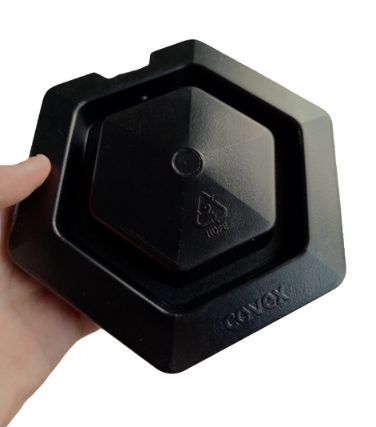
The hexagonal HDPE modules float, interlock and self-level to the lagoon surface. They reduce the exposed liquid area to a continuous physical barrier, with no power, no dosing and no active gas handling. Each unit carries water ballast that holds it in place as conditions change.
Cuts odor at source
Sealing 98% of the liquid surface keeps odorous compounds and amines in the liquid instead of in the air neighbours breathe. Quantified by independent olfactometry.
Reduces ammonia and methane
A reduced liquid-gas interface limits volatilisation at source, aligned with the BAT principle of cutting fugitive emissions rather than capturing them after they form.
Less evaporation, retained heat
The barrier cuts water-to-air exchange, while the air chamber in each module slows heat loss, useful through cold-season storage.
Built to outlast the permit cycle
UV-stabilised HDPE with 1% carbon black, the same specification logic as long-life HDPE pipe. Modular units are individually replaceable.
Sustained coverage is the BAT factor. It is engineered in.
A floating cover only controls emissions while it stays in place. Loss of surface coverage is a direct loss of control, and the most common reason covers fail to deliver on their permit. Covex® is designed around that risk.
Common failure modes of floating covers
- Wind uplift that lifts units off the surface
- Unit displacement and edge migration, exposing the liquid at the perimeter
- Stacking or "riding" of units on top of one another
- Incomplete or inconsistent coverage that worsens over time
How Covex® holds coverage
- Central factory-filled ballast. Each unit ships with pre-defined ballast for immediate stability and a controlled centre of gravity on deployment.
- Dynamic ballast channels. Secondary chambers fill under rain and agitation, adding weight exactly when conditions turn adverse.
- Anti-riding geometry. A wide edge profile prevents units lifting or stacking, keeping coverage continuous.
- Self-levelling behaviour. Self-levelling behaviour. Units self-arrange on the surface as the level changes.
One system across the stores that draw complaints.
The physics of the liquid-gas interface is the same; the regulatory and operational priority shifts with the store. Find yours below.
AD Digestate Lagoons
- Odor, ammonia and methane control over the largest emitting surface on the site.
- Supports a BAT-aligned permitting case through sustained, high-coverage emission control at source.
- Rainfall passes through into the lagoon and is managed through nutrient analysis and land-spreading rates, as standard in AD operations.
- Compatible with tractor-mounted mixing, or with a fixed base-mounted mixer for automated homogenisation without breaching the cover.
Slurry Stores
- Cuts odor and ammonia loss from stored slurry, reducing both nuisance and nutrient loss to air.
- Retains more nitrogen in the slurry for land application, improving fertiliser value.
- Independent olfactometry on pig slurry measured emission reductions that improve with surface coverage.
- Self-installs and self-adjusts with no structure, anchoring or perimeter tensioning.
Industrial & Reservoir Storage
- Odor and evaporation control over industrial lagoons and stored process water.
- Algae and quality protection for water held before reuse or discharge.
- Bird exclusion over open surfaces, reducing nutrient and pathogen inputs.
- Continuous physical barrier with no power draw and no parts to service.
A dynamic floating system, not a sealed membrane.
Covex® controls emissions by limiting the exposed surface, not by sealing the lagoon gas-tight. That distinction is what removes the pumps, drainage and failure points a membrane brings, and it is how floating covers are assessed in environmental permitting.
Rain passes through, by design
Rainfall enters the lagoon rather than pooling on the cover, so there is no surface loading, no drainage points and no pumps to maintain or fail. Ingress is managed through nutrient analysis and spreading rates, as standard in AD and agricultural practice.
No pumps, pipework or controls
There are no membranes to tension, no electrical drainage and no moving parts. That means no failure risk from blocked drains or pump malfunction, and a lower whole-life cost than a prescriptive sealed design.
Not gas-tight; performance depends on coverage
Covex® is not a gas capture system, and its performance depends on appropriate installation and coverage density. We state this plainly because it is exactly how regulators assess floating covers, and the case is stronger for it.

Covex® adapts to changing conditions while maintaining continuous surface coverage, the key to consistent emissions control.
Cover the lagoon without losing access to mixing.
A common question on a covered store is how the digestate stays homogenised. Covex® is compatible with both approaches, and is engineered so the cover and the mixing system work together rather than against each other.
Tractor-mounted mixing
- Compatible, with appropriate access design. Covex® can accommodate tractor-mounted stirring where the site layout allows for it.
- Familiar operation. Suits sites already set up for periodic agitation from the bank.
- Coverage maintained between cycles. The cover settles back to continuous coverage once mixing stops.
Fixed base-mounted mixing
- Automated homogenisation. A submerged or pumped base-mounted system delivers consistent, controlled mixing without manual intervention.
- Cover integrity preserved. Mixing happens from below, so there is no need to access or breach the floating system.
- Lower operational risk. Fewer interventions and less maintenance than repeated surface access, with stable, controlled digestate.
Evidence measured and modelled, not catalogue claims.
The performance figures are backed by independent testing and modelling of the same HDPE and water-ballast principle Covex® is built on. Its hexagonal geometry delivers high surface coverage, so performance is expected to meet or exceed these figures under comparable conditions.
Designed, supplied and supported end to end.
A complete coverage package
Site-specific layout and coverage design, installation methodology, performance and case-study data, and a commercial proposal, tailored to your lagoon geometry, wind exposure and access requirements.
Let's do the numbers.
Tell us about your store and we will provide a coverage design, an estimate of odor and emission reduction, and the supporting evidence for your permit.
A specialist will review your site data and respond with a coverage design and a savings and compliance estimate.
Technical Resources
Learn how floating covers reduce crust, emissions, and rainwater dilution in digestate and biogas lagoons: floating covers for digestate and slurry lagoons.