Starve the zebra mussel out of your network.
The zebra mussel does not arrive with food. It filters it out of your water: algae, bacteria, protozoa and fine organic detritus. Covex® seals the surface, cuts the light that feeds that chain, and holds the water below the temperature window where the colony breeds. You attack the infestation at its source instead of chasing shells through your pipes.
A reservoir is the colony's nursery.
Once Dreissena polymorpha establishes, it never stops. It attaches to any hard surface, breeds in your reservoir and seeds the entire network with microscopic larvae. By the time you find a shell in a sprinkler, the infestation is already downstream. Three problems compound at once.
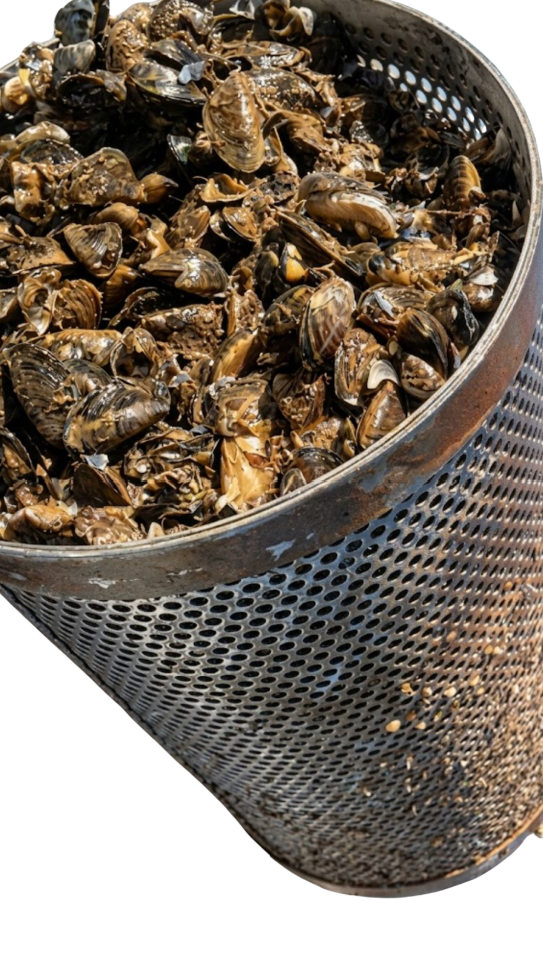
Clogged filters, pipes and drippers
Shells and live mussels block pump intakes, filters, valves and drip emitters. Detached shells over 30 mm travel downstream and damage meters and equipment. Pressure rises upstream, flow falls downstream, and pumping energy climbs.
Larvae seeded across the network
The reservoir breeds the colony and exports veliger larvae with every irrigation. Regulators measure significance at thresholds as low as 0.06 larvae per liter. One uncovered basin can reinfect a whole irrigation district.
Draining and manual cleaning
Conventional control means draining basins and scraping valves by hand, repeated season after season. Higher maintenance cost, more breakdowns, and shorter equipment life, on top of treatment chemicals that the mussel resists by closing its valves for weeks.
Cut the light, cut the food, close the breeding window.
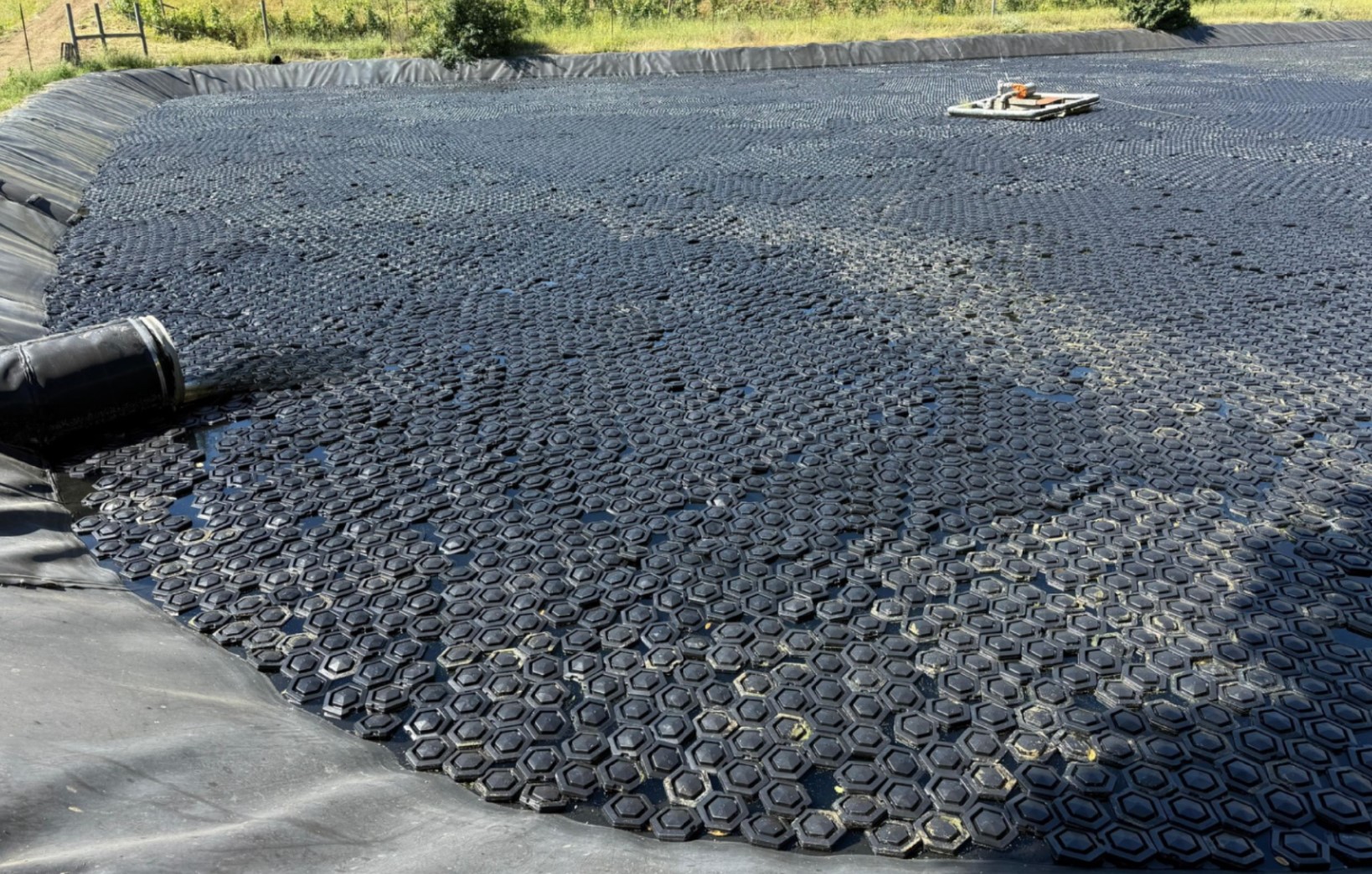
The zebra mussel is a filter feeder whose food chain starts with light-driven algae, and whose reproduction is locked to water temperature. Covex® attacks both. The hexagonal HDPE modules float, interlock and self-adjust to the level, with no structure, anchoring or maintenance, and water ballast that holds them in place in extreme wind.
Cuts the food at the source
By blocking light, photosynthesis collapses and algae growth drops by 95%. Less algae and suspended organic matter means less of the food the zebra mussel filters to grow and reproduce.
Seals the surface permanently
50 hexagons per m² cover 98% of the surface with near-zero light penetration, day after day. No gaps, no maintenance, no algaecides or bactericides.
Holds water below the breeding window
In summer the cover keeps the water several degrees cooler, helping hold it below the 15-17°C optimum reproductive band and reducing larval emission into the network.
Recovers the water too
The same barrier cuts evaporation by up to 97%, keeps birds off the surface and reduces odors, protecting the water you already paid to store.

Where the cover changes the fight.
The biology of the zebra mussel is universal, but where Covex® helps most depends on your infrastructure. Find your operation below.
Irrigation Communities
- Break the reinfection loop: the covered reservoir breeds far fewer larvae, so it stops seeding the whole district with veligers every irrigation cycle.
- Protect shared infrastructure: fewer clogged filters, valves and emitters across the network means lower maintenance cost spread over every member.
- Modular deployment with no civil works: no structure, no anchoring, no need to drain the basin. Operational the day it is launched.
- Self-adjusting to level as the reservoir drains through the season, with no maintenance crew required.
Regulating Reservoirs
- Attack reproduction at the source: by holding the water below the 15-17°C breeding window in summer, the cover reduces the larval load leaving the basin.
- Cut the food chain: 95% less algae and lower suspended organic matter starve the filter-feeding colony.
- Less draining and manual scraping: fewer fouling cycles means fewer shutdowns to empty and clean.
- Recovers stored water too: up to 97% less evaporation on the same surface you are protecting.
Pressurized Networks
- Fewer shells reaching the network: less reproduction upstream means a lighter load of larvae and detached shells hitting filters and emitters.
- Protect filtration and pumps: lower fouling reduces pressure loss, backflushing and energy at the pumps.
- Works with your treatment, not against it: Covex® is the structural foundation under chemical dosing and filtration, removing the food and the light those methods cannot.
- No light, no algae, no biofilm forming on wetted surfaces in the storage stage.
Reproduction has a temperature window. Covex® closes it.
The zebra mussel does not breed at any temperature. Its reproduction is locked to a narrow thermal band, and summer is when an uncovered reservoir walks straight into it. By blocking solar radiation, Covex® holds the water cooler and helps keep it below the optimum reproductive window, exactly when larval emission peaks.
In summer, it holds the water below the breeding band.
As the open surface heats through a summer day, it climbs into the optimum reproductive window just as larval emission peaks. That is how a single basin seeds an entire network with veligers. By blocking 98% of solar radiation, Covex® keeps the water several degrees cooler, helping hold it under the 15-17°C band and shortening the time the colony can spawn.
The thermal map of the colony.
Field temperature records show how tightly the zebra mussel is bound to water temperature. Below 10°C it cannot reproduce. Its peak spawning sits in a narrow band around 15 to 17°C, with maximum growth of settled mussels just above. Push the water out of that band and you cut directly into reproduction and larval emission.
Covex® does not freeze or boil the colony out, and we will not claim it does. What it does, working day after day through the summer, is shave several degrees off the water and shorten the time it spends in the breeding window, turning the season's heat from the colony's ally into something you control.
No reproduction. The colony cannot spawn.
Optimum reproduction. Peak larval emission.
Optimum growth of settled mussels.
Lethal limit for the species.
A powerful barrier, used as part of a strategy.
No single method eradicates the zebra mussel, and we will not claim otherwise. The animal is highly adaptable and can close its valves for weeks when it senses a chemical agent, which is exactly why chemical dosing alone so often disappoints. Covex® is the structural foundation of a control program: it removes the food and the light, and closes the breeding window, working alongside proper filtration and, where needed, targeted treatment.
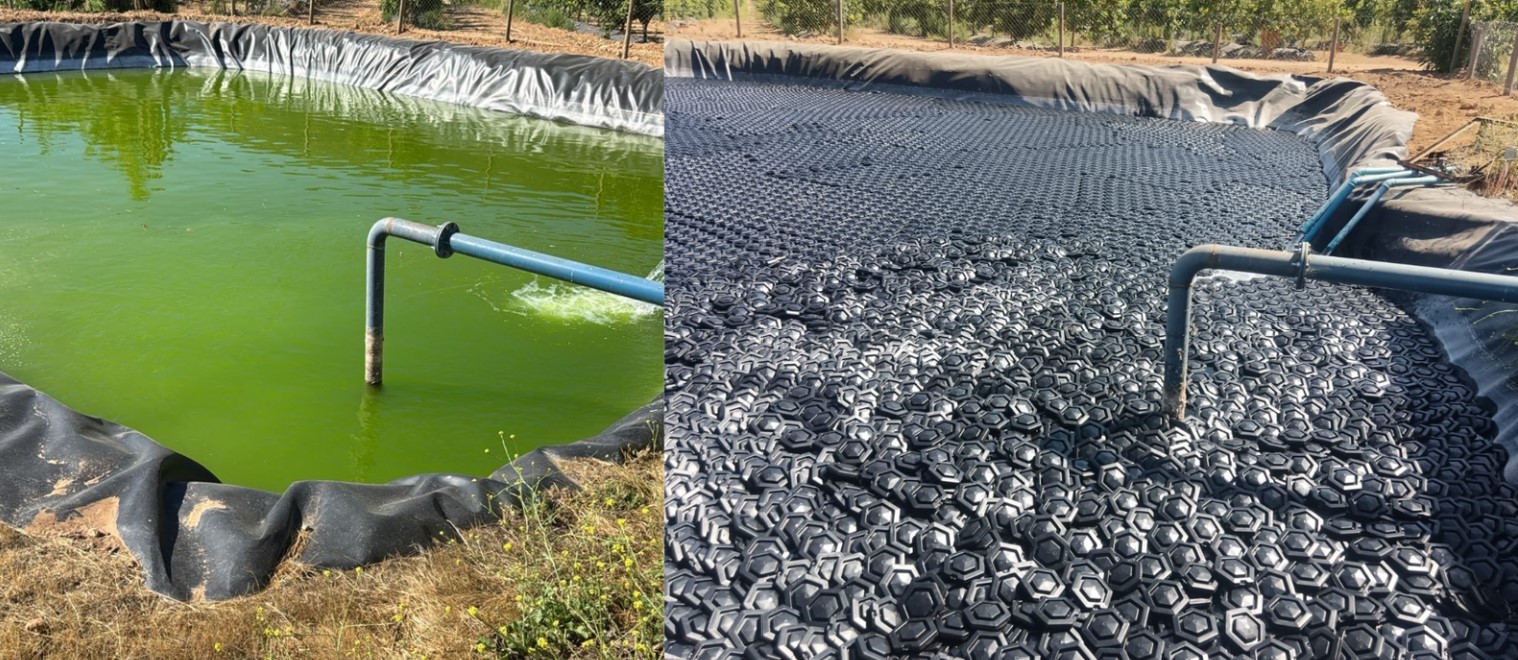
Removes the food and the light
Blocking 98% of solar radiation collapses algae growth by 95% and lowers suspended organic matter, starving the filter-feeding colony of the food it draws from the water column.
Closes the breeding window
By holding the water below the 15-17°C optimum reproductive band in summer, the cover reduces spawning events and the larval load exported into the network.
It is not a standalone cure
The mussel is adaptable and resists chemical shock by closing its valves. Covex® shifts the balance decisively against the colony, but it works best combined with filtration and, where required, targeted treatment.
24/7, with no dosing or power
The barrier works around the clock with no chemicals, no energy and no labor, and the hexagons rearrange themselves as the level changes. It ends the drain-and-scrub cycles caused by uncovered, sunlit water.
Data measured on site, not catalog promises.
Let's do the numbers.
Tell us about your reservoir and the infestation you are facing. We will assess whether Covex® fits your site and what it would change for your control program and your maintenance costs.
Thank you for reaching out. A Covex® specialist will review your request and get back to you.
Technical Resources
Learn how blocking light with a floating cover cuts the energy that fuels zebra mussel infestation: floating covers for zebra mussel control.