Your reservoir loses water every single day.
Covex® is a hexagonal HDPE floating cover that seals the water-air interface. It cuts evaporation by up to 97%, blocks the light that feeds algae, and removes the open water surface that attracts birds. The water you were allocated, pumped or paid for stays in the reservoir until your crops need it.
An uncovered reservoir is an open-air evaporator.
In Spain, an open water surface evaporates between 1.5 and 1.85 m³ per square meter of surface every year, depending on the region. On a 10,000 m² reservoir that is between 15,000 and 18,500 m³ gone without irrigating a single hectare.
Annual evaporation by region
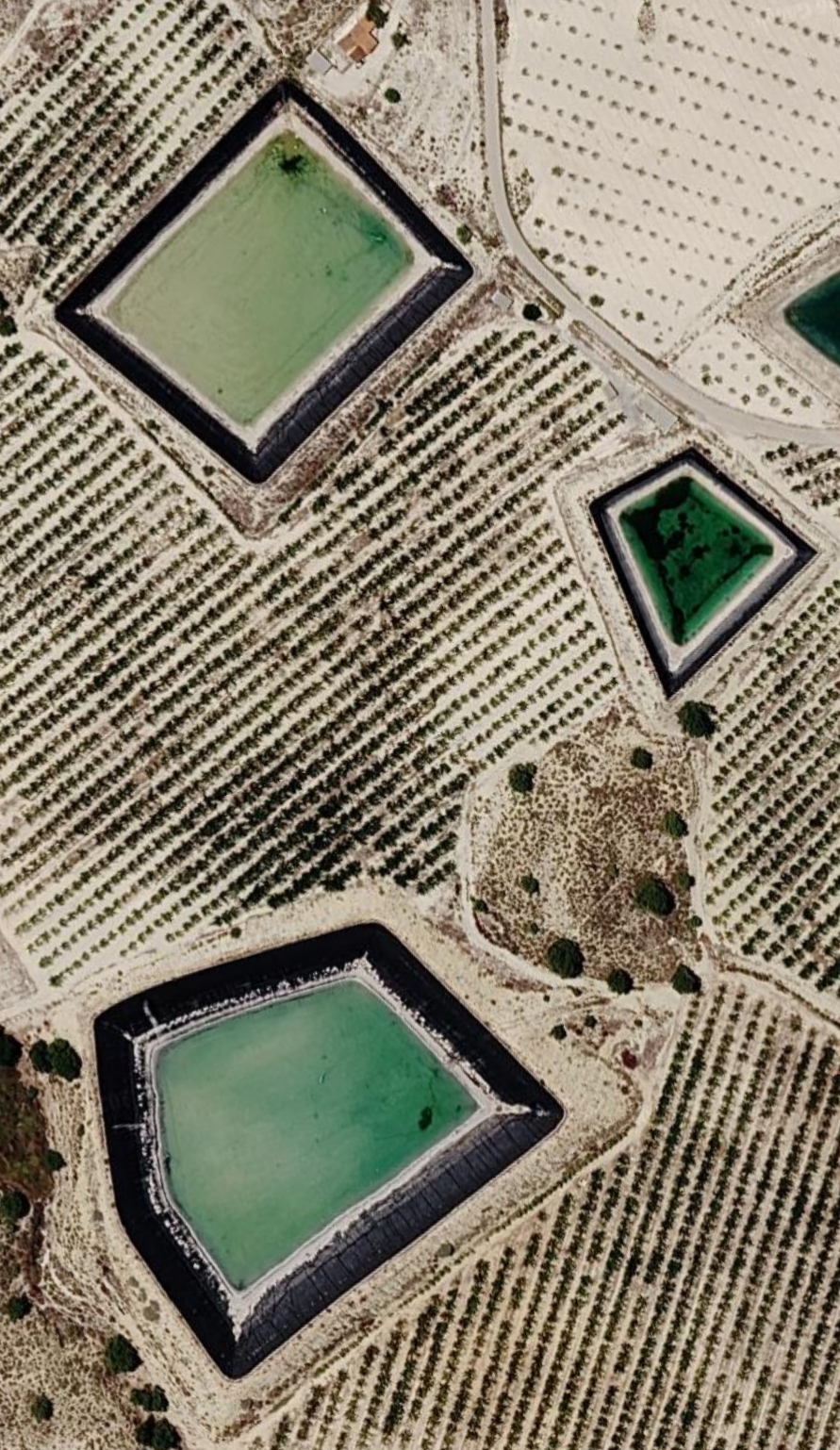
Water evaporates exactly when you need it most.
The loss is not spread evenly across the year. Roughly two thirds of annual evaporation is concentrated between May and September, which is exactly the window when the crop is drawing water, when the allocation is already committed, and when there is no room left to replace anything.
On a 10,000 m² reservoir in Almería, for example, those five months take around 12,000 m³. This is not water lost in winter, when there is plenty. It is water that disappears in the middle of July, the month when every cubic meter decides whether a plot makes it to the end of the season.
That is why a floating cover behaves differently from other water efficiency investments: it performs at its best precisely at peak demand, with no pumps, no electricity and no operation.
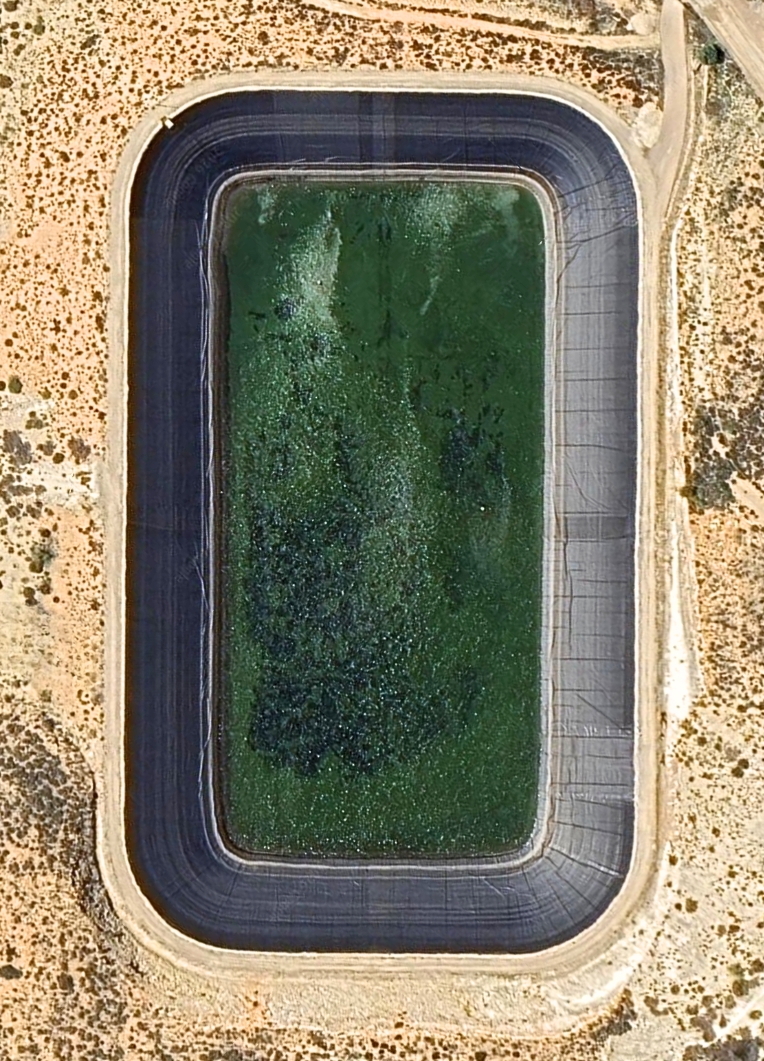
Evaporation
The loss concentrates in the months of peak demand. Water disappears when the crop needs it most, and no concession or borehole makes up for a long summer.
Algae and drip clogging
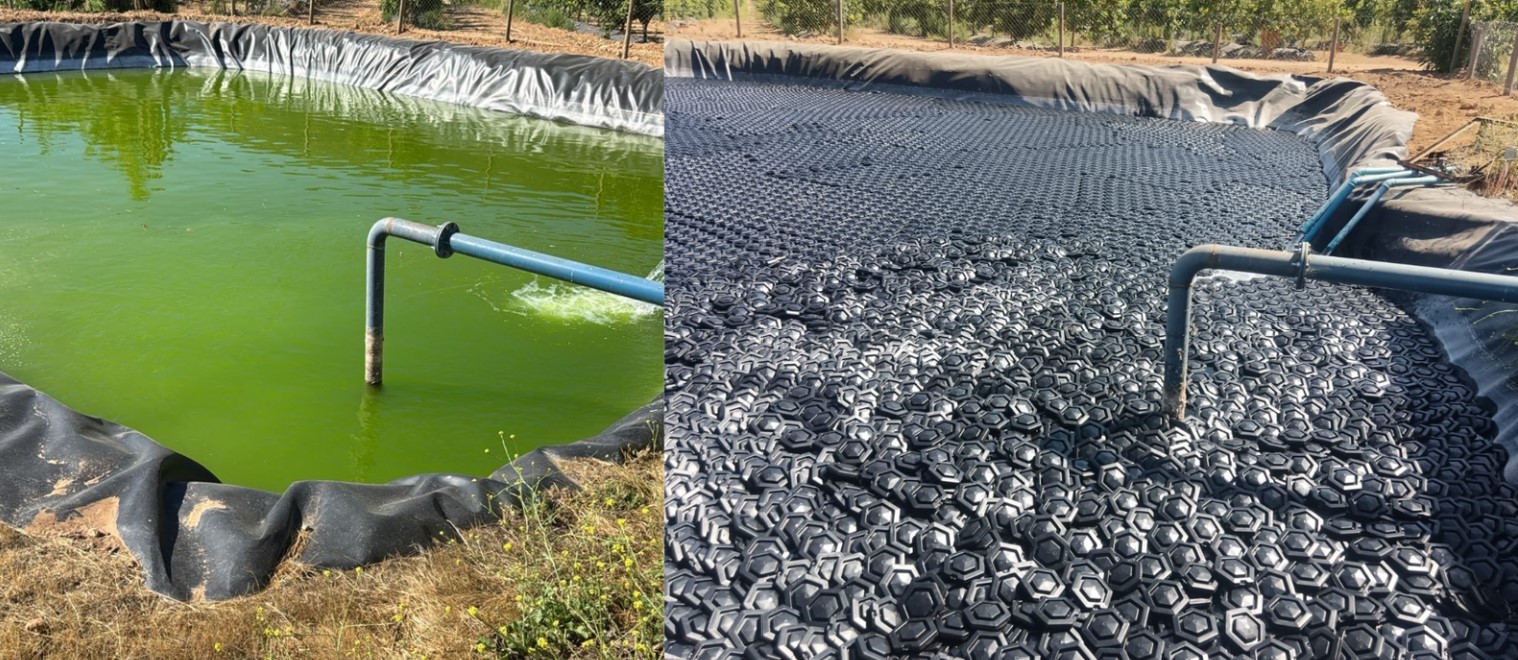
Light, temperature and nutrients drive blooms that clog emitters, multiply filter backwashes and force chemical treatment of water that then goes to a food crop.
Birds and water quality
An open water surface attracts birds that introduce pathogens and nutrients into irrigation water. It is a recurring finding in food safety audits and a permanent load on filtration.
In Spain water is rarely expensive. It is scarce.
When water is billed in cents per cubic meter, calculating the return on a floating cover from the water price alone produces a number that convinces nobody. That calculation measures the wrong variable.
The real constraint on a Spanish reservoir is not the cost per cubic meter, it is the available allocation: the licensed volume, what you manage to store before the season, and what is left when the river basin authority cuts back. What a floating cover buys is not euros saved on the water bill, it is hectares you can keep irrigating in August of a dry year, and growing seasons that are not lost to a restriction.
Where water does carry a real price (desalinated, deep-lift boreholes, market water in a dry year, pumping with an energy cost), the direct financial return appears on its own and is usually the fastest argument.
The right metric: m³ available in season, not €/m³ savedHow many m³ does your reservoir lose between May and September? Tell us where it is and its surface area and we run the calculation.
Calculate my seasonal lossThe same physics. Three ways to justify the investment.
The behavior of the water-air interface is universal. What changes is who decides, with what budget and against what criteria.
Irrigation communities
- At collective scale, evaporation is an allocation problem: every cubic meter that evaporates is water already assigned on the register that no member ever gets to use.
- Fits irrigation modernization: the item can be built into the technical report of a water saving project and into regional and national grant applications.
- No civil works, no draining: it needs no structure, no anchoring and no service interruption. The reservoir keeps operating during installation.
- Self-levelling: the hexagons follow the water surface as the reservoir draws down through the season, with no maintenance crew.
Private farms and estates
- Direct return wherever water has a cost: desalinated, deep boreholes, market water, or pumping with an electricity bill tied to the cubic meter.
- Protects drippers and fertigation: no light means no photosynthesis, and no algae means fewer clogged emitters, fewer backwashes and less algaecide.
- Shaded water: blocking 98% of solar radiation cuts the light that drives algae and limits solar heating of the water at peak hours.
- Fast decision: no general assembly, no tender and no waiting for a grant window. Installed in days.
Agrifood industry and cooperatives
- Auditable water quality: a continuous physical barrier, with no active devices to fail and no electricity, working around the clock.
- Bird exclusion over water destined for food processing, a recurring critical point in private standard audits.
- Odor control on reservoirs with organic load: the cover reduces the release of odorous compounds to the surroundings.
- Operational continuity: less algae and biofilm downstream, with fewer cleaning shutdowns and less treatment.
A cover that installs itself and adjusts itself.
Hexagonal HDPE modules that float, interlock and settle on their own to the reservoir level. No structure, no anchoring and no maintenance. Each unit carries water ballast in its central chamber, lowering its center of gravity and holding it in place even in strong wind.
Less evaporation
The physical barrier cuts mass exchange between water and air, with 98% of the surface permanently covered.
Less algae growth
Blocking light inhibits photosynthesis in the stored water, protecting emitters, filters and fertigation quality.
Almost no open water
With no visible reflective surface, birds struggle to identify a body of water to land on or drink from. The deterrence is structural, with no need for cannons, nets or lasers.
Years of expected service life
HDPE with carbon black, UV additives and antioxidant. 10-year warranty.

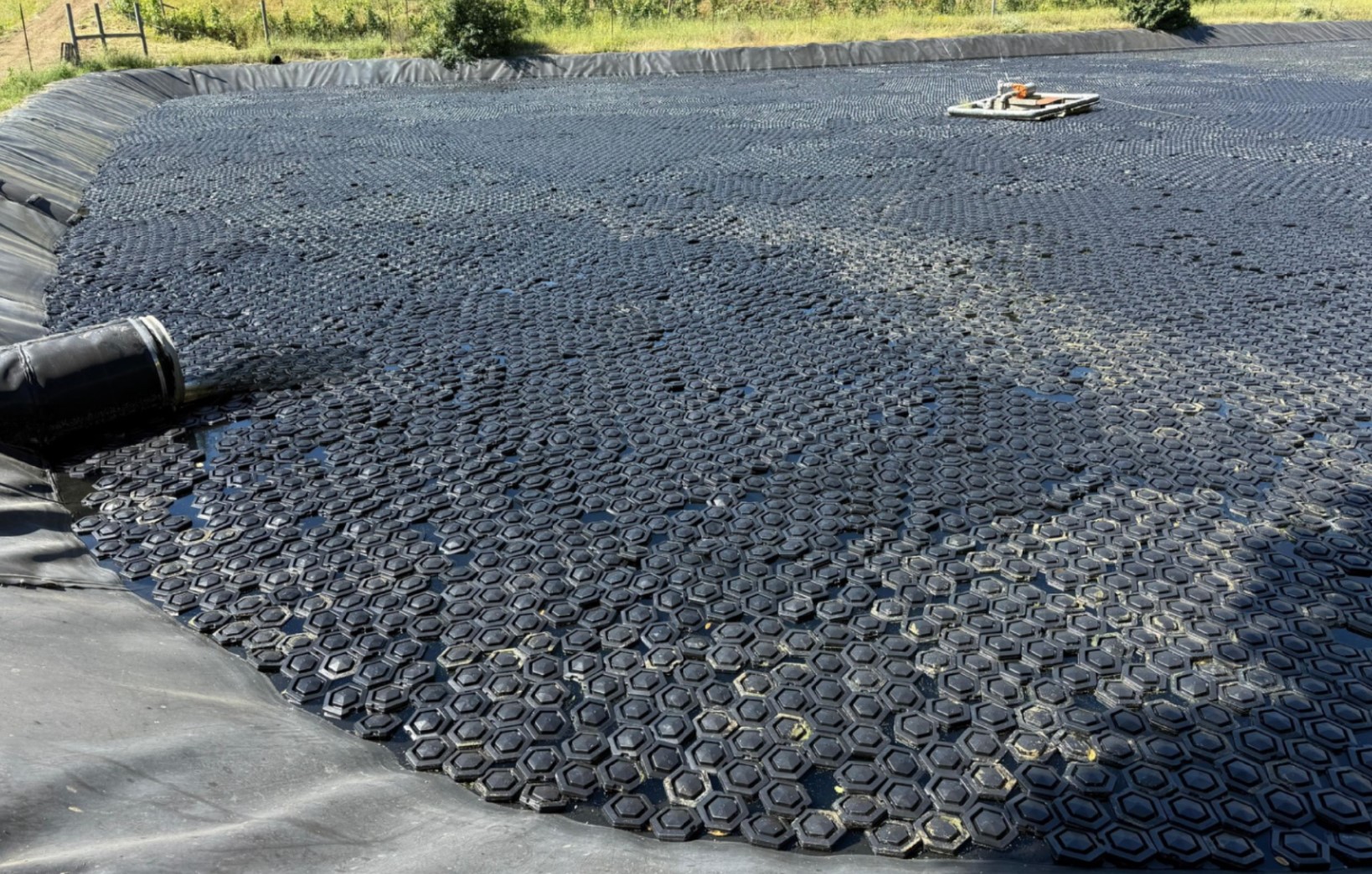
See a Covex® cover working on a real reservoir. One minute, then the numbers for yours.
Cooler at peak sun, liquid water on a frost night.
The cover slows heat exchange between the water and the air, by day and by night. For a reservoir feeding frost protection irrigation, the night effect is operational, not incidental.
It slows temperature changes in both directions
The cover intercepts sunlight and slows heat exchange with the air. Water warms up later in the day, so at peak sun it runs about 4 °C cooler than uncovered water, and at night it loses heat more slowly, which is what keeps it liquid on a frost night.
Figures calculated for your site, not catalog promises.
How to compare floating covers without getting it wrong.
The modular floating cover market has several solutions and at first glance they look alike. The differences that determine real performance are not in the catalog. These are the six questions worth asking any supplier.
Measured reduction, not declared coverage
Geometric coverage and evaporation reduction are not the same thing. In an independent three-year comparative trial of four floating cover systems, a product claiming more than 95% reduction measured 28% once corrected. The gap between what is declared and what is measured is the buyer's real risk.
Sealed water ballast
An unballasted hexagon floats high and carries its center of gravity above the water surface. Covex® holds water in a sealed chamber: the unit weighs 270 g with its center of gravity below the waterline. That is the difference between a cover that stays formed and one that drifts with the wind.
Behavior in waves and wind
A reservoir with wind or an inflow generates surface movement. Unballasted systems lose formation, pile up against a bank and expose open water precisely during the hours of highest evaporation. Covex® withstands up to 100 km/h.
Exposed profile above the waterline
Every part of the unit above the waterline is surface for the wind to push against. Bulky units with protrusions or fins catch more wind for the same covered area, and without ballast they pile up against one bank. Covex® sits only 27 mm above the water, with its ballast below the waterline.
Material and declared service life
Not every modular cover on the market is made from the same polymer or with the same UV protection. Covex® is manufactured in UV-stabilized HDPE with carbon black, virgin or recycled as the project requires, with an expected service life of more than 25 years and a 10-year warranty.
Site-specific report
Savings on a reservoir in Almería, in Lleida and in Lugo look nothing alike. A catalog percentage is no basis for sizing an investment or justifying a grant application. We deliver a calculation using climate data for your location, the geometry of your reservoir and its actual filling and drawdown regime.
Already have a quote from another supplier? Send it over and we answer the six questions above for both products.
Compare my quoteThe investment is decided on net cost, not on the quoted price.
Where a floating cover can fit
Grant lines for irrigation modernization and water saving have been the real engine of water technology investment in Spain over the past decade. Floating photovoltaics on reservoirs is the clearest precedent for how a well used funding window transforms a market in two seasons.
A floating cover can fit as a water saving measure within modernization projects, both in regional calls funded by EAFRD and the Spanish CAP Strategic Plan and in works promoted through the state agricultural infrastructure company. Each call defines its own eligible items, deadlines and solvency requirements.
What we do: we prepare the technical documentation in the format the call requires, with the savings calculation expressed in cubic meters and as a percentage of allocation, which is the criterion used for scoring.
What we deliver for your application
Preparing a modernization or water saving application? We prepare the technical report and savings calculation in the format your call requires.
Request the report packageFrom premium wine estates to commercial nurseries and orchards.

Let's run the numbers on your reservoir.
Tell us where it is and how much surface it has. We will send back an estimate of annual evaporation, recoverable water, treatment savings and payback period for your specific site, and a reference site with a comparable crop if you want one.
Thank you for reaching out. A Covex® specialist will review your request and get back to you.
Why floating covers are becoming standard practice in irrigation storage.
A technical review of evaporation losses, algae control and water security in agricultural reservoirs:Irrigation Reservoir Evaporation in Spain: How Much Water You Really Lose
