Irrigation Reservoir Evaporation in Spain: How Much Water You Really Lose
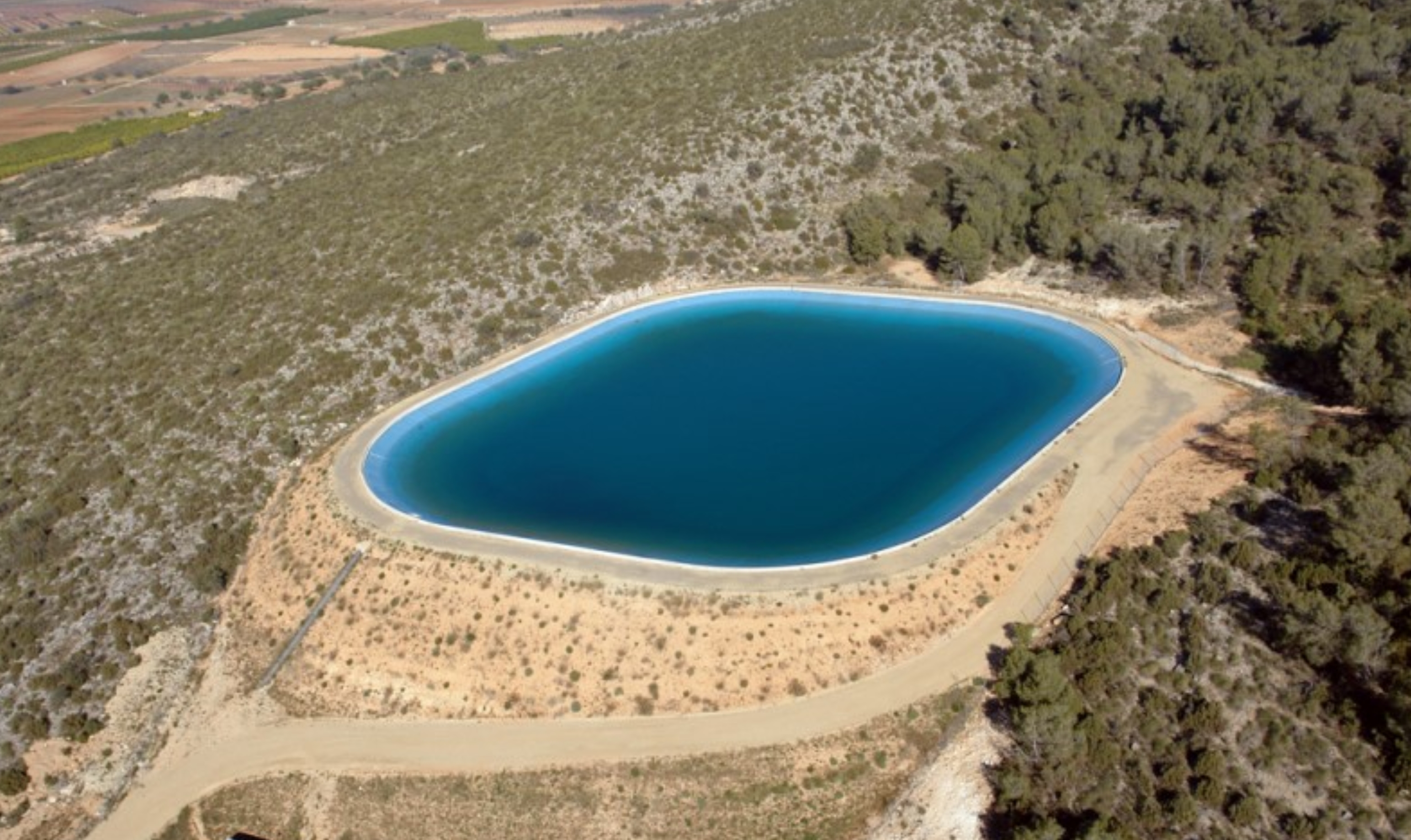
Ask a farmer in Murcia or Almeria what their eservoir loses to evaporation and most will say "a lot" and leave it there. It is one of the few water losses in Spanish agriculture that nobody meters, nobody bills and almost nobody budgets for. It does not leak, it does not break, and it does not show up on any invoice.
It is also, in most of the Spanish peninsula, larger than people expect.
The numbers, and why sources disagree
Open water in Spain evaporates somewhere between 1.5 and 1.9 cubic meters per square meter of surface per year, depending on the region. On a one hectare reservoir, that is between 15,000 and 19,000 m3 leaving through the surface without irrigating anything.
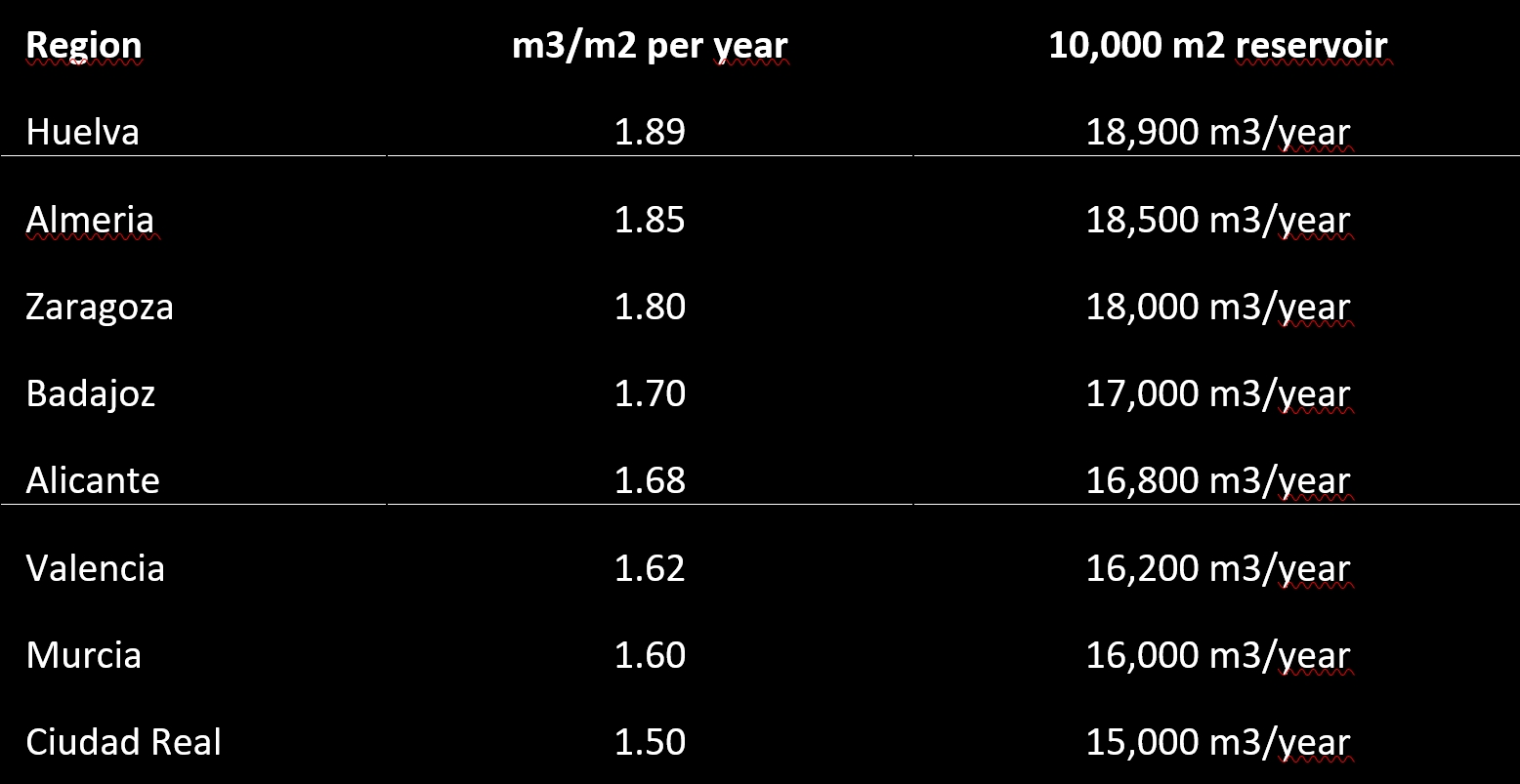
If you go looking for published figures, you will find a wide spread, and the spread is not noise. It comes from two things: the measurement method, and the type of water body being measured.
Temez, working with Class A evaporation pan sacross peninsular reservoirs, reported values for Andalusian reservoirs between1,382 and 1,982 mm per year. Later work applying FAO Penman-Monteith to a large sample of Andalusian reservoirs produced a mean closer to 1,296 mm per year. For irrigation reservoirs specifically in the Region of Murcia, published estimates run between 1,600 and 2,000 mm per year, while a research group at the Universidad Politecnica de Cartagena has used a figure of around 1,400 mm for reservoirs in the Levante.
That is a spread of roughly 40% between the low and high published values, and any supplier quoting you a single number with outsaying which method it came from is skipping the most important part.
Why a farm reservoir evaporates more than a dam
The lower figures in the literature generally describe large, deep reservoirs. Those have thermal inertia: they store heat through the day, lag behind air temperature, and the surface stays cooler than you would expect from the weather alone.
A farm reservoir behaves nothing like that. It is shallow, it is small, and it has a high perimeter relative to its surface. It tracks ambient temperature with almost no lag, and it sits surrounded by dry, hot ground that pushes warm dry air across the water, an advective effect that adds to evaporation rather than moderating it.
So when a technician tells you that Penman-Monteith gives 1.30 for Andalusian reservoirs and your supplier is quoting 1.85, both can be right. They are describing different objects. Spanish hydrological planning applies different pan coefficients precisely for shallow water bodies for this reason.
The part that actually hurts: seasonality
Annual totals understate the problem, because evaporation is not spread evenly across the year.
Roughly two thirds of annual evaporation happens between May and September. That is the same window in which the crop is drawing water, in which the seasonal allocation is already committed, and in which there is no realistic way to refill.
On a 10,000 m2 reservoir in Almeria, those five months account for something in the order of 12,000 m3. That is not water lost in February when the reservoir is full and it does not matter. It is water that disappears in July, when every cubic meter is deciding whether a plot makes it to harvest.
This is why evaporation control behaves differently from most water efficiency investments. Its performance peaks exactly when demand peaks, and it does so with no pumps, no electricity and no operator.
Why the euros-per-cubic-meter calculation fails in Spain
Here is where most evaporation control proposals lose the room.
In a Spanish irrigation community, water may be billed at a few cents per cubic meter. Multiply 16,000 m3 by five cents and youget 800 euros a year, which will not justify covering a reservoir on any spreadsheet. The calculation is arithmetically correct and strategically useless, because it measures the wrong variable.
The binding constraint on a Spanish reservoiris not the price of water. It is the availability of water: the licensed concession volume, what you managed to store before the season started, and what remains after the river basin authority applies a restriction in a dry year.
Framed that way, the question changes. It is no longer how many euros you save on the water bill, but how many hectares you can still irrigate in August of a dry year, and how many growing seasons you do not lose to a restriction.
There are exceptions where the direct financial return works on its own, and they are worth identifying early: desalinated water, deep-lift boreholes with a real energy cost per cubic meter, market water purchased in a dry year, and high-value greenhouse crops where a single lost season dwarfs the cost of the cover.
The options, honestly compared
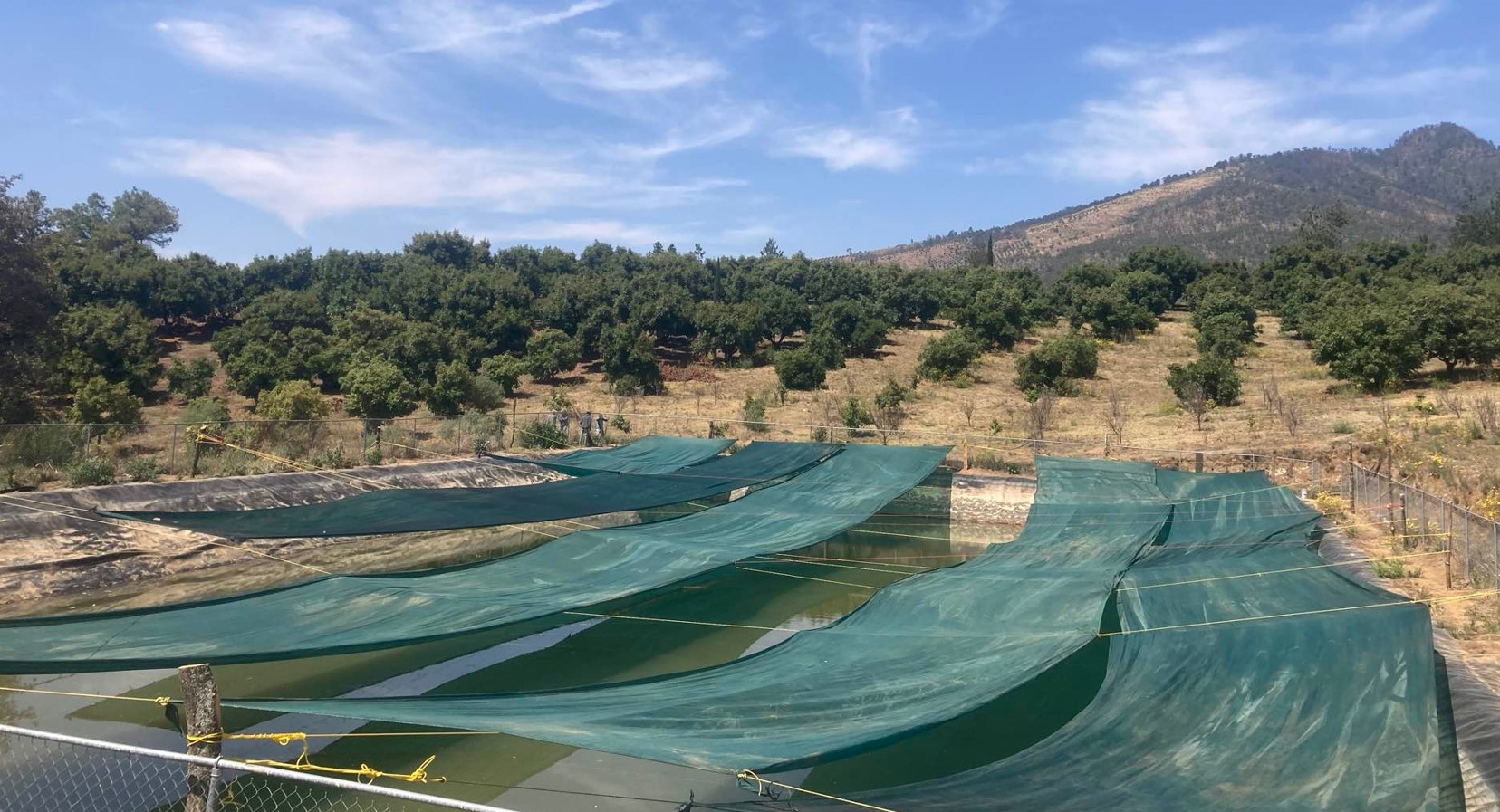
Shade structures and suspended covers
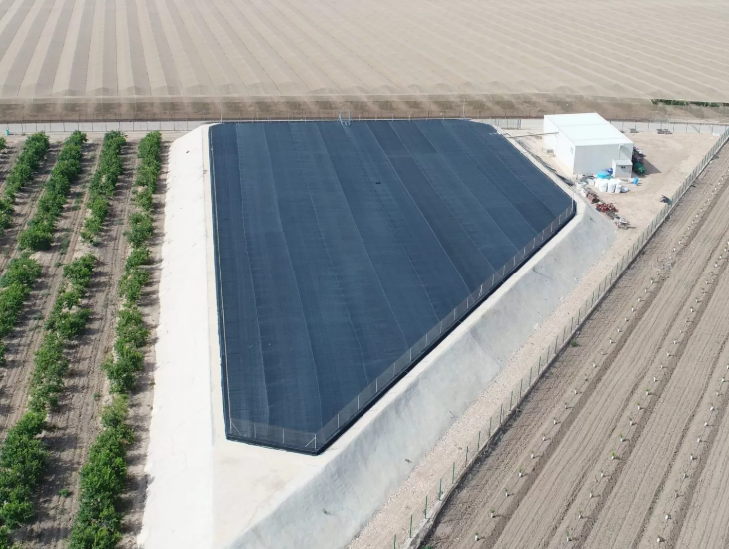
Effective, and also the most expensive by awide margin. They need engineered supports, foundations and periodic structural inspection. They make sense on small, high-value tanks, rarely on a hectare of irrigation storage.
Continuous floating membranes
High coverage and good performance, but they demand careful design for rainwater drainage, gas venting and access, and repairs are a specialist job. They also complicate maintenance and inspection of the underlying liner.
Floating photovoltaic
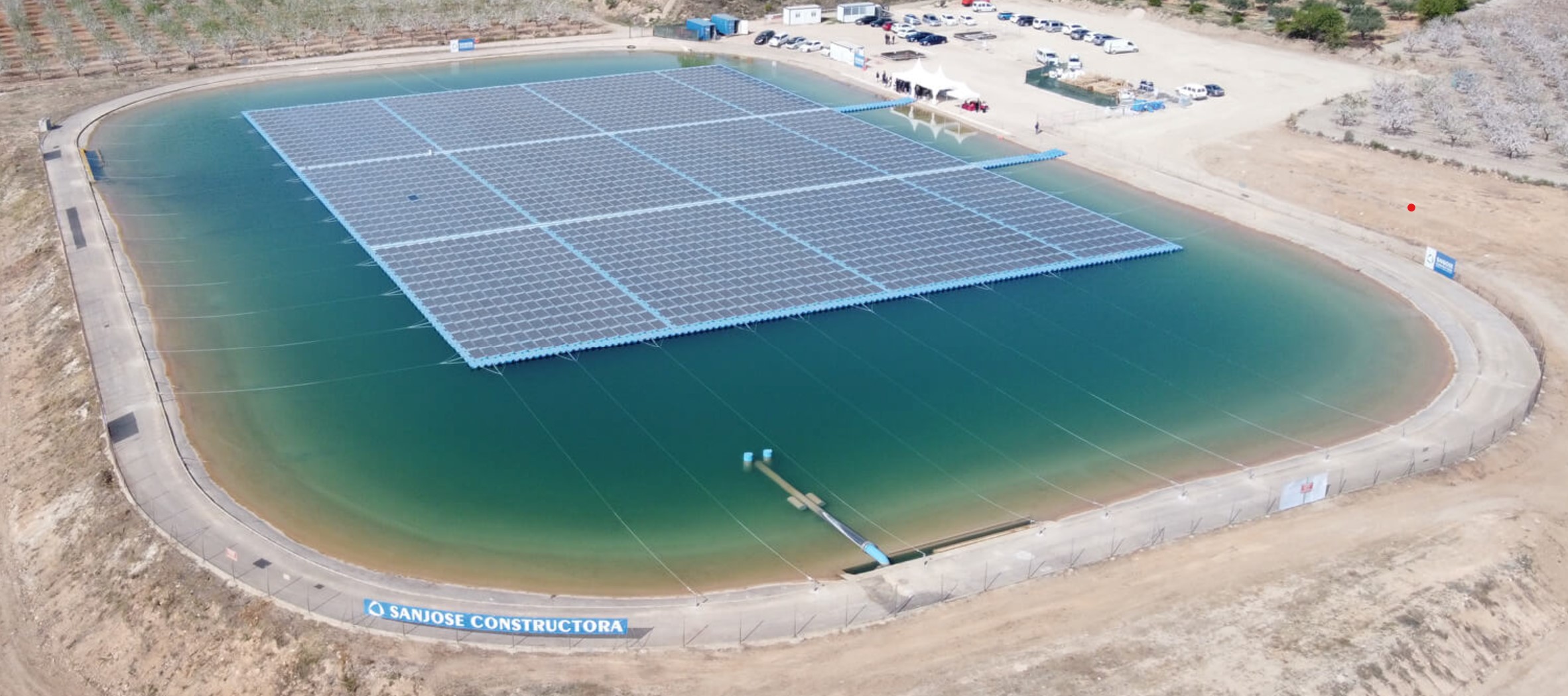
Growing fast in Spain and genuinely attractive because it generates revenue rather than avoiding a loss, which is a much easier case to take to a general assembly. Coverage of the water surface is usually partial, so the evaporation benefit is real but secondary to the energy benefit.
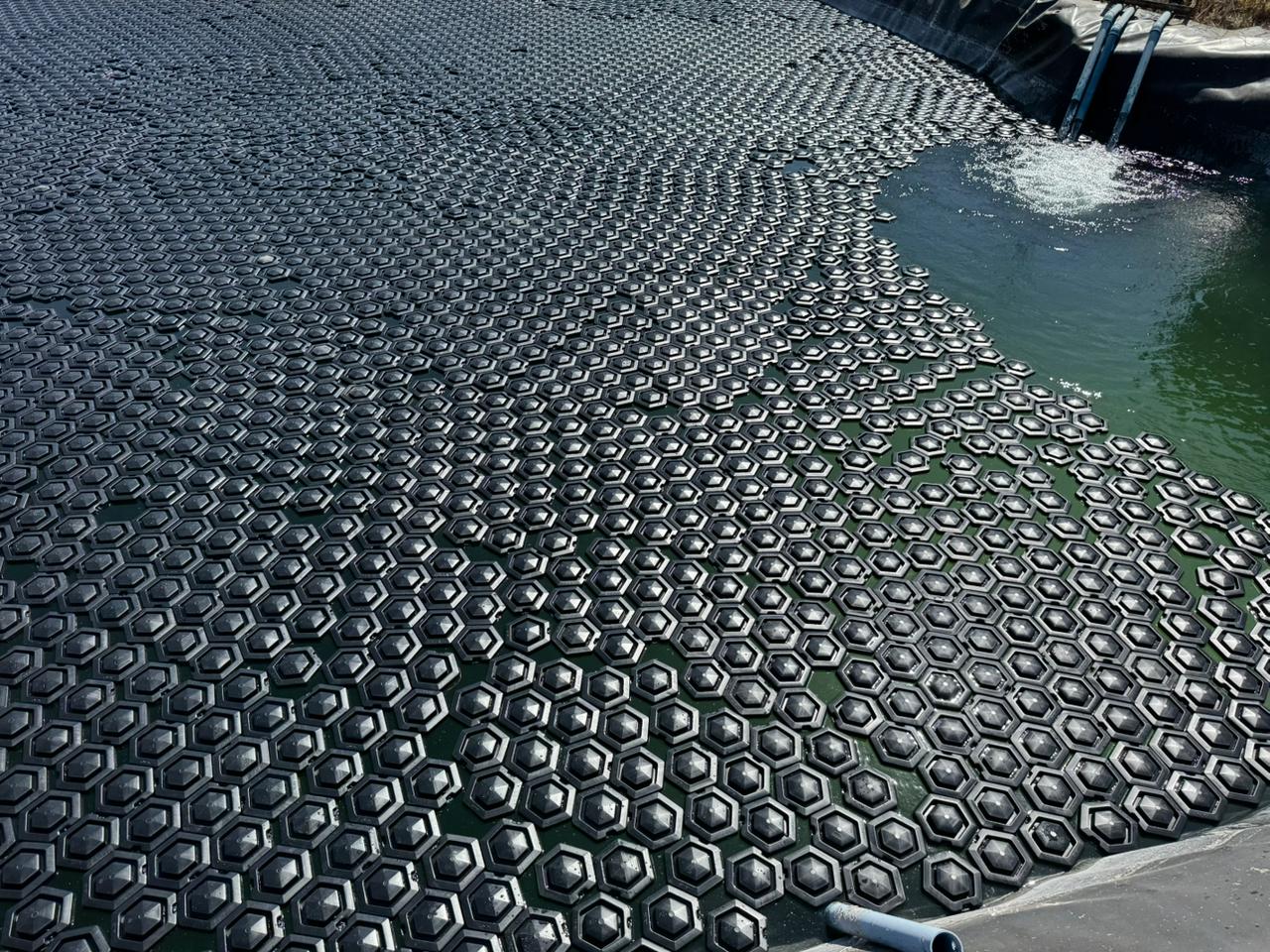
Modular floating covers
Individual floating elements that self-arrange, follow the water level as the reservoir draws down, and need no structure, anchoring or civil works. They install without draining the reservoir and without interrupting service, which for a shared reservoir in season is often the deciding factor.
How to evaluate a modular cover
If you go down the modular route, the differences that determine real performance are not the ones printed in the catalog. Four questions separate the products.
Is the figure geometric coverage or measured reduction? These are not the same thing, and the gap between them can be enormous. In an independent three-year comparative trial of four floating cover systems, one product claiming over 95% reduction measured 28% once corrected. Separately, a Spanish university field trial on a modular floating cover over a real agricultural reservoir measured a reduction of 77.5% over a full year. Those are the kinds of numbers worth asking for.
Does the element carry ballast? An unballasted element floats high with its center of gravity above the waterline. Elements that carry water ballast in a sealed chamber sit lower and hold formation. This is the single biggest predictor of whether a cover stays where you put it.
How much of the element sits above the water? Everything above the waterline is surface for wind to push against. Bulky shapes with protrusions or projecting fins catch more wind for the same covered area, and combined with little ballast that is what makes a cover pile against one bank and expose open water on exactly the windiest days.
What polymer, and what warranty in writing? HDPE with carbon black at around 1% is the same UV specification used in HDPE pipe rated for decades. Ask for the polymer, the UV package and the warranty document, not the brochure.
Funding
Grant lines for irrigation modernization and water saving have been the real engine of water technology investment in Spainfor the last decade. Floating photovoltaic is the clearest precedent for how a well used funding window can transform a market in two seasons.
Evaporation control can fit as a water saving measure within modernization projects, in regional calls funded by EAFRD andthe Spanish CAP Strategic Plan and in works promoted through the state agricultural infrastructure company. Each call defines its own eligible items, deadlines and solvency requirements, so the practical work is making sure the technical documentation is written in the format the call scores against, with savings expressed in cubic meters and as a percentage of allocation.
Where to start
Before comparing products, get an evaporation figure for your own reservoir. Not a catalog percentage, but a calculation using climate data for your location, the geometry of the reservoir and its real filling and drawdown regime through the season. That number is what tells you whether this is worth pursuing, and it is also the number a grant application will be scored on.
→ Learn more about floating covers for evaporation control: /balsas