Same outorga. More water in your operation.
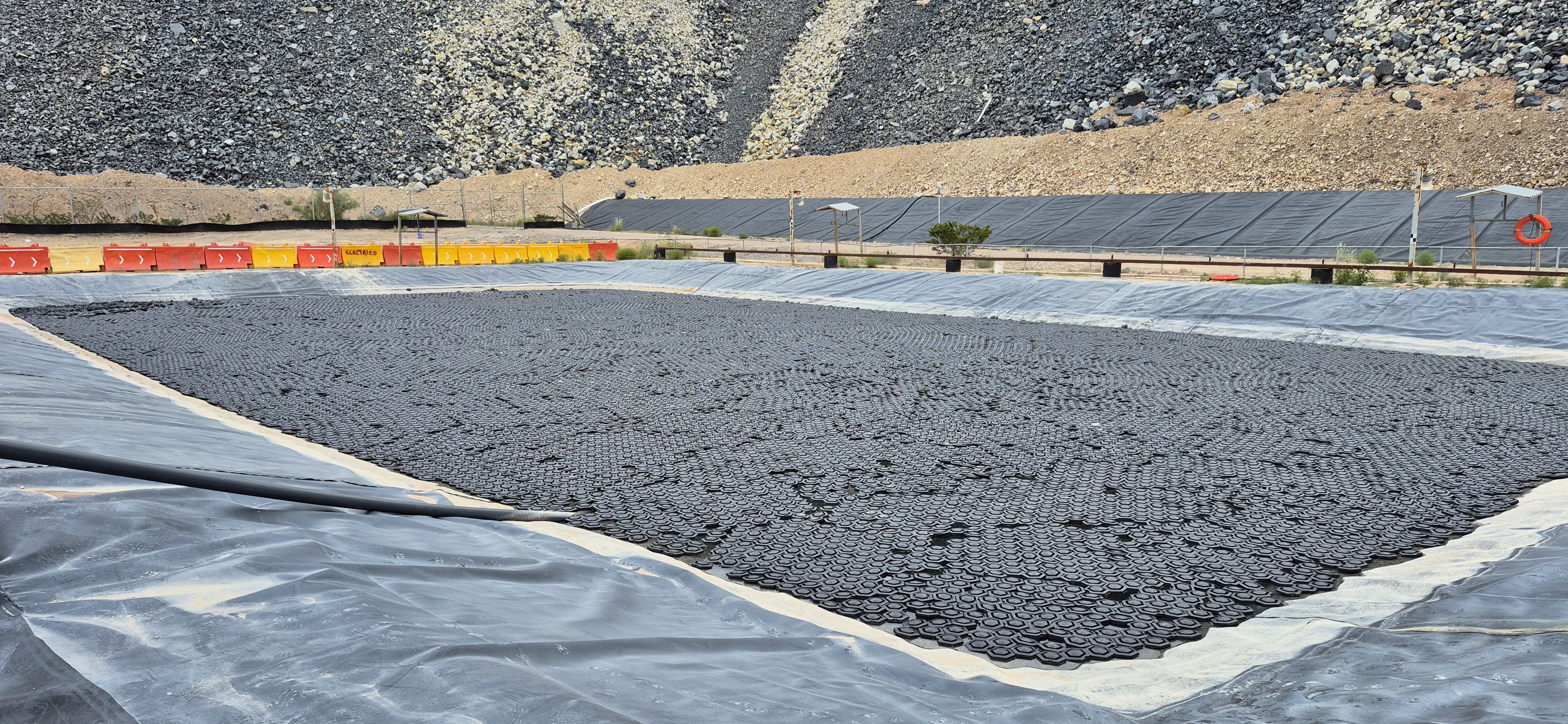
The rainy season fills your reservoir, and the outorga sets how much of it you are allowed to withdraw. Every millimeter that evaporates is taken twice: from the water you stored and from the volume you are already licensed to use. Covex® is a hexagonal floating cover that seals the water-air interface, recovering up to 97% of that loss, blocking algae and removing the open water surface that attracts wildlife, with no new permit, no civil works and no interruption to the operation.
It all starts at the water-air interface.
Wherever your stored or process water meets the air, the same things happen, regardless of what you mine: water evaporates, light feeds algae, airborne dust settles on the open surface, and the exposed water draws in wildlife. In Brazil, annual pan evaporation ranges from around 1,500 mm in the Iron Quadrangle of Minas Gerais to more than 2,000 mm in the semi-arid north of the state, for example. The final figure is calculated from the climate series of your own site.

Evaporation
The most contested resource on site is lost to the open air: 1.5 to 2 m³ of water per m² of exposed surface per year. Evaporation is the only leak nobody repairs. It drains the volume your outorga already granted you, and it does it every single day.
Algae and water quality
Radiation on the open surface fuels photosynthesis. Blooms degrade water quality, clog pumps and filters, and force extra treatment across fresh, process and recycled water alike.
Dust and suspended solids
Haul roads, crushing and materials handling generate particulate matter that settles on the open water surface. The result is more suspended solids, silting, and wear on pumps, precisely where the water should be clean.
Wildlife and compliance
The exposed water surface attracts birds and animals to reservoirs that may hold process solution. Covering the surface reduces the risk of wildlife fatalities and the penalties that follow.
How much water is your pond losing right now? Tell us its location and surface area and we send you a quotation with the estimated water recovered.
Request a quotationA cover that self-installs and self-adjusts.
The hexagonal modules float, interlock, and settle on their own to the reservoir level. They require no structure, anchoring, or maintenance. Each unit carries water ballast that keeps it in place even in strong wind.
Less evaporation
The physical barrier of the hexagons cuts the mass exchange between water and air. 98% coverage of the liquid surface.
Stops algae growth
By blocking light, it inhibits photosynthesis in the stored water, preserving water quality.
Removes the open water surface
With no visible reflective surface, birds and animals are far less likely to detect the reservoir, so they stay away.
Wind resistance
The design and water ballast make the hexagons to sink halfway and mantain a stable coverage when facing high wind gusts..

The same cover, the value that matters to you.
The physics of the water-air interface is universal, but the priority changes with the mineral and the process. Iron ore, gold and copper account for more than 74% of the value of Brazilian mineral production, and each one reaches water by a different route. Find your operation below.
Iron ore
- Recovers outorga volume: the water evaporating from your industrial water reservoirs was already authorized, already withdrawn and already paid for. Recovering it requires no new application.
- Wet processing and recirculation: every m³ that stays in the reservoir is one m³ less of fresh withdrawal during the dry season.
- Road watering for dust control competes for the same outorga volume. Cutting evaporation losses frees water for that use.
- Blocks dust from entering the water surface, reducing the suspended solids that wear pumps and load the treatment circuit.
Gold
- Cyanide Code alignment: a continuous physical barrier that keeps birds and wildlife away from cyanide-bearing solutions.
- Auditable wildlife exclusion that does not rely on active devices such as nets, cannons or lasers.
- Evaporation control on barren and pregnant solution ponds, recovering both water and solution.
- Lower reagent loss: sealing the surface limits cyanide volatilisation and blocks the ultraviolet radiation that drives its photodegradation.
Copper
- Brazilian copper is mostly sulphide ore concentrated by flotation, so the main gain is in the water balance: less fresh water to replace what evaporates from process and reclaim water ponds.
- Material formulated for environmental stress cracking resistance (ESCR), the critical factor in contact with aggressive solutions.
- Where hydrometallurgy is in place, the air chamber inside each module holds the solution temperature and improves leaching kinetics.
- Wildlife exclusion on acidic ponds, an increasingly frequent licensing requirement that regulators verify on site.
Other minerals
- Bauxite and alumina: washing and refining are water intensive, with fresh and recycled water reservoirs exposed to evaporation and algae all year round.
- Phosphate and niobium: high radiation and a long dry season, with pan evaporation above 1,600 mm per year.
- Lithium: semi-arid climate, restrictive outorga conditions and evaporation above 2,000 mm per year. This is where every recovered m³ carries the highest marginal value.
- Nickel, zinc and graphite: process and recycled water reservoirs, with the same gains in water quality and wildlife exclusion.
The case is not the cost of water. It is the volume you are already authorized to use.
Under the Brazilian water resources framework, what limits the operation is not the water in the basin, it is the volume your outorga allows you to withdraw. When that volume is the constraint, the question stops being what the cover costs and becomes what running out of water costs.
A water-limited circuit that runs short does not slow down, it stops, and a stopped operation can cost millions per day. Against that, every cubic metre the cover keeps in the reservoir is production protected.
Recovers water you are already authorized to use
The water that evaporates came out of your outorga. Recovering it requires no new application to the water authority, no new intake and no civil works. It is volume already inside your right of use that is currently lost to the atmosphere.
Avoids a new intake, pipeline or bore
Adding supply through a new intake is slow, expensive and subject to licensing. The evaporation a cover recovers can replace the yield of more than one bore, without opening a new process.
Protects exactly when water is short
Every Brazilian mining region has a dry season; only the calendar changes. In Minas Gerais and the cerrado it runs from May to September. In Carajás it stretches to October, with August as the driest month. In both cases the deficit peaks exactly when radiation and vapour pressure deficit push evaporation to its maximum..
Installed on the operating asset, no prep work
No site preparation, no draining, no downtime. The cover is deployed directly onto the water surface while the reservoir stays in service.
Evaporation loss modelled, not assumed
The savings are not a sales claim. We quantify the evaporation loss of your specific reservoir using the local climate series, so the business case rests on numbers you can audit.
Removable when it is time to reline
When an ageing asset eventually needs a new liner, the cover is removed, the liner installed, and the cover put back. A fixed geomembrane cover cannot offer that.

Building the business case for your site? We quantify the m³ your outorga is losing to evaporation, the intake you avoid and the payback, with numbers your team can audit.
Build my business caseLess radiation on the water, less evaporation, and temperature protected.
Covex® works on the water-air interface, and what it protects depends on what is in the pond. Water at ambient temperature warms up later in the day and runs cooler at peak sun. Process solution carries the heat the circuit gave it, and the cover holds that temperature stable instead of letting the sun and the air pull it around.
It slows temperature changes in both directions.
The cover intercepts sunlight before it reaches the water and slows heat exchange with the air. Water warms up later in the day, so at peak sun it runs about 4°C cooler than uncovered water, and at night it loses heat more slowly. In Brazil radiation stays high even through the dry winter, which is precisely when replacing water is hardest.
Where hydrometallurgy exists, temperature is energy you already paid for.
Process solution carries the heat the circuit gave it. The air chamber inside each module acts as an insulating barrier: it holds that temperature stable, shields the solution from the swings the open air would impose, and reduces the heat the circuit would otherwise have to replace. In leaching operations that means less auxiliary energy and more stable kinetics.
In Brazil the effect shows up in operations with hydrometallurgy and in heated solution ponds. In flotation circuits the relevant gain remains the water balance and water quality.
Protect wildlife and back your compliance.
Preventing wildlife contact with process solutions is a critical priority in licensing and in audits. Covex® provides a continuous physical barrier that removes the visible open water surface, becoming an auditable measure to mitigate wildlife risk and ensure operational continuity.
No open water, no attraction
By covering 98% of the surface, birds are unlikely to perceive a body of water to land on or drink from. The deterrence is structural and does not rely on active devices.
HDPE grade for aggressive environments
High-density polyethylene withstands contact with acidic and cyanide-bearing solutions. The formulation prioritises environmental stress cracking resistance (ESCR), the critical factor in mining chemistry.
Independent technical validation
The system has evaporation and thermal-behavior validation through TRNSYS, ANSYS Fluent and CFD modelling, with academic institutions and water research centres.
Zero maintenance, automatic adjustment
The hexagons rearrange themselves as the level changes. There is no structure to inspect and no anchors to fail during an audit.
"Implement measures to protect birds, other wildlife and livestock from adverse effects of cyanide process solutions."
The Code requires operations to restrict wildlife access to any open water where WAD cyanide exceeds 50 mg/l. Among the measures it explicitly recognizes are fencing, filling collection ditches with gravel, and covering or netting the solution in ponds and impoundments, including the use of floating covers. It also notes that hazing techniques, cannons, lasers and similar active deterrents, are typically not adequate on their own to meet this Standard of Practice.
Covex® delivers this exact measure as a continuous floating barrier: it removes the open water surface that attracts wildlife, works passively without active devices, and self-adjusts with the solution level, giving auditors a permanent, inspectable control rather than one that depends on equipment that can fail.

Preparing a Cyanide Code audit or an environmental licence renewal? Ask for the documentation describing Covex® as a passive, inspectable wildlife barrier.
Request compliance documentationData measured on site, not catalog promises.
Installed at the largest mining companies in the world.

Want to hear it from an operation already using Covex®? Ask for a reference site with a comparable process and climate.
Ask for a reference siteLet's do the numbers.
Tell us about your reservoir and we will provide an estimate of evaporation, recovered volume and payback for your site.
Thank you for reaching out. A Covex® specialist will review your request and get back to you.
Technical Resources
Why every millimeter that evaporates from a mine site reservoir is spent directly against the outorga, and what part of that loss is actually controllable: floating covers for mine site reservoirs in Brazil.