12.3.2026
The Most Commonly Installed Solution for Evaporation and Algae in Ponds is Also the Least Effective
Agriculture
Evaporation
Algae
Water
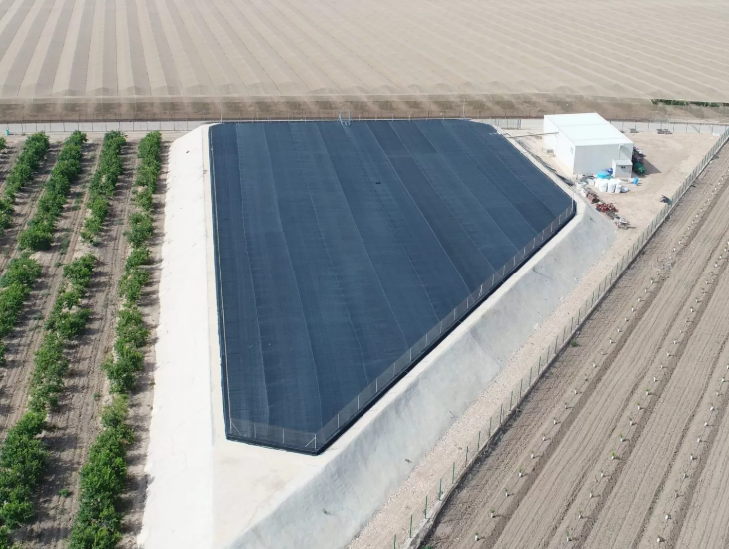
Shade nets are sold to solve two problems in agricultural reservoirs: water evaporation and algae growth. There is a concrete physical reason why they solve neither one.
If you visit an agricultural operation with irrigation ponds, you might find a shade net tensioned over it. It is installed with two simultaneous objectives: reducing evaporation and controlling algae growth. It is the dominant market solution. Suppliers recommend it, growers use it and it appears in consultants' technical datasheets.
The problem is that it solves neither one. It marginally attenuates both, but does not eliminate them. And the reason is strictly physical in both cases.
What causes evaporation? Dalton explained it in 1801.
Since John Dalton formalized his model in Manchester, the physical mechanism has been clear and has not changed: evaporation is proportional to the difference in vapor pressure between the water surface and the air above it, amplified by wind speed.
As long as the air above the water is drier than the liquid surface, water evaporates. Without exception. There is no way to stop that process as long as the water-air interface exists.
And algae growth depends on another equally simple factor: light. Algae photosynthesize. Without light, they do not grow. With any amount of light reaching the surface, the cycle is not interrupted.
Why the shade net fails at both evaporation and algae
A shade net is installed between 30 and 80 cm above the water surface. By reducing the solar radiation that heats the water, it lowers the surface temperature. The commercial logic seems reasonable: lower temperature → lower vapor pressure → less evaporation. And less heat → slower algal metabolism.
But there are two physical problems this logic ignores:
Problem 1: Evaporation: The net leaves hundreds of thousands of openings between the water and the atmosphere. Wind enters, constantly renewing the air above the surface, and the hygrometric deficit remains active. The water-air interface is not eliminated — it is merely pushed a few centimeters away. Dalton's equation continues to operate uninterrupted.
Problem 2: Algae: The net is elevated, not resting on the water. Sunlight penetrates at oblique angles through each opening, diffuses through the intermediate air space, and reaches the surface with sufficient photosynthetically active intensity to sustain algae growth. A partial attenuation of light is not enough to interrupt photosynthesis.
The shade net is sold to address evaporation and algae. But it does not rest on the water, and that difference of a few centimeters is everything.
Covex®: cutting both problems at their source
The hexagons do not float with an intermediate air gap. They rest directly on the water surface, with water ballast in their central chamber keeping them semi-submerged and stable even in winds exceeding 100 km/h.
By covering 98% of the surface, both mechanisms that the net cannot address are simultaneously eliminated: the water-air interface disappears across that covered fraction, and sunlight is blocked at the surface level, not 50 cm above it, where diffusion is inevitable.
Covex® Physical advantage
A shade net can moderate water temperature. But it cannot block vapor exchange with the outside air, nor effectively block light at the surface level, because it is physically separated from the water. Covex has no such intermediate gap.
No additional chemical treatments. No periodic algaecides. No filter cleaning for biofilm at the same frequency. Darkness and the elimination of the interface are the most effective, side-effect-free means of controlling stored water quality.
The physics hasn't changed since 1801. The solution just hadn't caught up, until now.
Want to see all the benefits of floating covers for your farm? Learn more here: https://www.covex-cover.com/agriculture
Share